
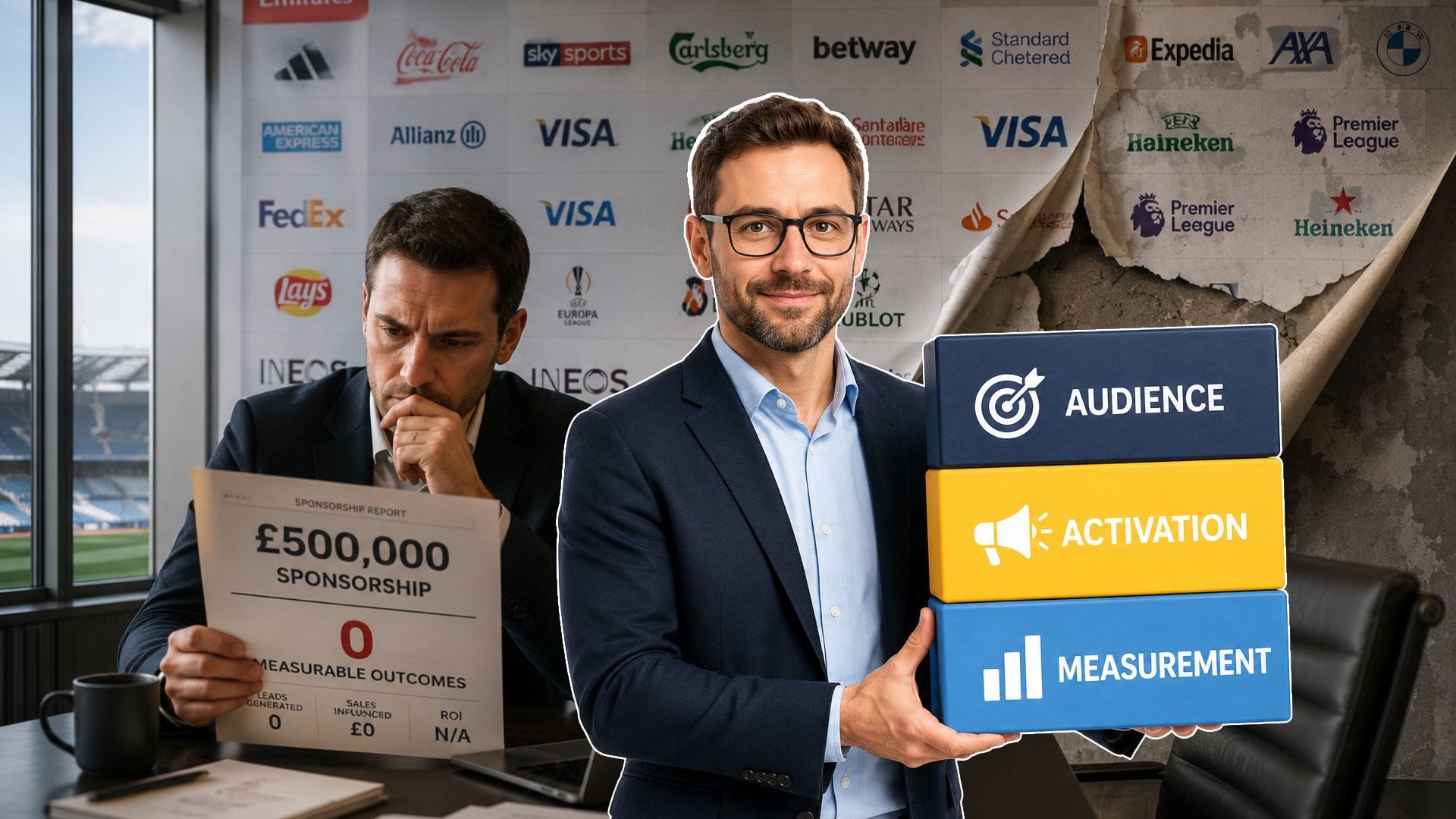

Sports sponsorship marketing has never had more opportunity than it does right now. And most brands are still squandering it. July 2026 is the most sport-saturated month in recent memory. Wimbledon. The British Grand Prix. The Open Championship. The Commonwealth Games. A World Cup final. More eyes on sport than at almost any other point in the calendar year. More sponsorship budgets deployed than ever before. More logos on boards, shirts and hospitality suites. Yet the gap between investment and commercial return has rarely been wider.
This is not a funding problem. It is a thinking problem.
The State of Sports Sponsorship in 2026
Global sponsorship spend is projected to exceed $115 billion in 2026, according to Statista’s Sports & Sponsorship Outlook. That number keeps climbing. The measurement of what all that money actually achieves, however, remains woefully underdeveloped across the industry.
Most brands are buying visibility and calling it a strategy. They secure the deal, receive the logo placement rights, brief the design team on the asset sizes and consider the job done. The sponsorship is live. The brand is ‘in sport’. Except none of that translates automatically into awareness, affinity or revenue.
The rights are the starting point. They are not the strategy.
The Logo-on-Everything Problem
The most common mistake in sports sponsorship is treating it as a media buy rather than a marketing platform. Pitchside boards, shirt logos and hospitality suites carry real value in the right hands. Without an activation strategy behind them, they are expensive wallpaper.
Consider what July 2026 looked like for the average mid-tier sponsor at a major event. Their branding appeared in broadcast shots. Their executives attended hospitality. A press release went out when the deal was signed. Then silence. No content programme. No audience engagement. No narrative thread connecting the sponsorship to what the brand actually does or stands for.
The investment was real. The thinking was not. As a result, the audience, the same audience the brand spent significant money to reach, had no meaningful reason to notice, remember or act.
This is the logo-on-everything problem. Ubiquity without purpose produces nothing but sunk cost.
What Good Sports Sponsorship Marketing Actually Looks Like
The brands that extracted genuine commercial value from the summer 2026 calendar did so through three disciplines applied consistently. Relevance. Activation. Measurement. These are not abstract principles. They are the operational difference between a sponsorship that works and one that does not.
Relevance: Audience Alignment Over Vanity
Relevance means genuine audience overlap, not aspirational association. The question every brand should ask before signing a rights deal is simple: does the person in those stands, watching that broadcast or following that athlete on social media look like our customer? If the answer requires significant qualification, the deal is not right.
At Wimbledon in 2026, the brands that performed best were not necessarily the biggest spenders. They were the brands whose product or positioning connected naturally with the audience’s values and identity. Relevance cannot be manufactured after the fact. It has to be built into the brief before the contract is signed.
Activation: Treating the Deal as a Content Platform
Activation is where most sports sponsorship marketing budgets go to die. Most brands treat activation as an event-day consideration rather than a season-long content strategy. The deal should function as a content platform that runs continuously, not a switch that flips on matchday or tournament week.
At Silverstone this summer, the brands that generated the strongest social engagement were running narrative-led content for weeks before the British Grand Prix weekend. Driver access. Behind-the-scenes production. Fan-facing campaigns with genuine creative. The event was the peak, not the entirety, of a planned programme.
The same logic applies at every level of the sponsorship market, from a Premier League shirt sleeve to a regional cricket ground.
Measurement: Commercial Outcomes, Not Just Reach
Reach and impressions are not commercial outcomes. They are inputs. The measure of a good sponsorship is whether it moved something that matters to the business: brand consideration, lead volume, customer retention or direct revenue. These outcomes require a measurement framework defined before the deal is activated, not reverse-engineered afterwards.
The brands doing this well at The Open Championship this summer set explicit KPIs against each activation strand. They tracked sentiment shifts, direct traffic attribution and sales uplift windows aligned to broadcast dates. Their agencies built reporting into the activation plan from day one.
That is the standard the industry should be working to. Most of it still is not.
How the Same Rules Apply to B2B and FMCG Brands
Nifty works with brands that are not household names: FMCG challengers, regional businesses and B2B companies exploring niche sport partnerships. The principles above apply at every level of the market. A regional sponsorship of a rugby club or a cycling event carries the same fundamental logic as a global naming rights deal. Does the audience align? Is there an activation plan? How will you measure it?
For FMCG brands in particular, sport offers something that most other channels struggle to replicate: genuine contextual relevance at the point of consumption. Consumers watching sport are often doing exactly what an FMCG brand wants to reach them doing: socialising, relaxing and in purchase-adjacent mindsets. The opportunity is significant. The execution still has to earn it.
Our PR and marketing services for FMCG and challenger brands are built around exactly this kind of commercially grounded thinking. You can see how we have applied it in practice through our Wye Valley Brewery case study and our work with Rebel Kitchen and our thinking on scaling UGC marketing.
How to Evaluate a Sports Sponsorship Opportunity
Before signing any deal, every brand should be able to answer these questions clearly.
Does the audience overlap genuinely with your target customer? Not aspirationally. Evidentially. Request audience data from the rights holder and interrogate it.
What is the activation plan and who owns it? The rights holder will not activate on your behalf. You need a content strategy, a production plan and a channel strategy before the deal is live.
How will you measure commercial impact? Define your KPIs before activation begins. Agree measurement methodology with your agency before the ink is dry.
What does success look like in 12 months? Sponsorship compounds over time when activated consistently. Set a long-term benchmark, not just an event-week metric.
What is the exit strategy if it is not working? Build review clauses into multi-year deals and set clear performance thresholds.
The Nifty Angle: What Good Looks Like From the Inside
Our founder Christian has worked at the highest levels of sport: the Premier League, Chelsea FC Foundation and motorsport. He has been inside the rooms where these decisions are made and has seen what separates a sponsorship that delivers from one that drains budget for three years without a return.
That experience is not background colour. It directly shapes how Nifty approaches every brand partnership, including the questions we ask before recommending a deal, the activation frameworks we build and the measurement standards we hold our work to.
We do not bring the standard of a generalist agency that has read the case studies. We bring the standard of people who have lived inside them. You can see what that looks like in our client work.
Frequently Asked Questions
What is sports sponsorship marketing?
Sports sponsorship marketing is the practice of partnering with sporting events, teams or athletes to reach a target audience and drive commercial outcomes. Effective sports sponsorship goes beyond logo placement. It requires a defined activation strategy, audience alignment and measurable KPIs tied to business objectives.
How do you measure the ROI of a sports sponsorship?
ROI in sports sponsorship is measured by tracking commercial outcomes defined before the deal is activated: brand consideration uplift, direct website traffic during event windows, lead generation and sales data. Reach and impressions are inputs, not outcomes. A robust measurement framework should be agreed with your agency before activation begins.
What is the difference between sponsorship and activation?
Sponsorship refers to the rights acquired through a commercial partnership: logo placements, hospitality access and broadcast mentions. Activation is what you do with those rights to generate commercial value. Without an activation plan, sponsorship rights deliver little beyond visibility.
How much should a brand spend on activation versus rights fees?
Industry guidance suggests brands should spend between 50% and 100% of the rights fee on activation to extract full commercial value. Many brands spend significantly less, which is why so many sponsorships underperform against expectations.
Sports sponsorship marketing in 2026 offers an extraordinary commercial opportunity, but only for the brands that treat it as a discipline, not a transaction. If you are investing in sport and want to make sure that investment works commercially, let’s talk.