
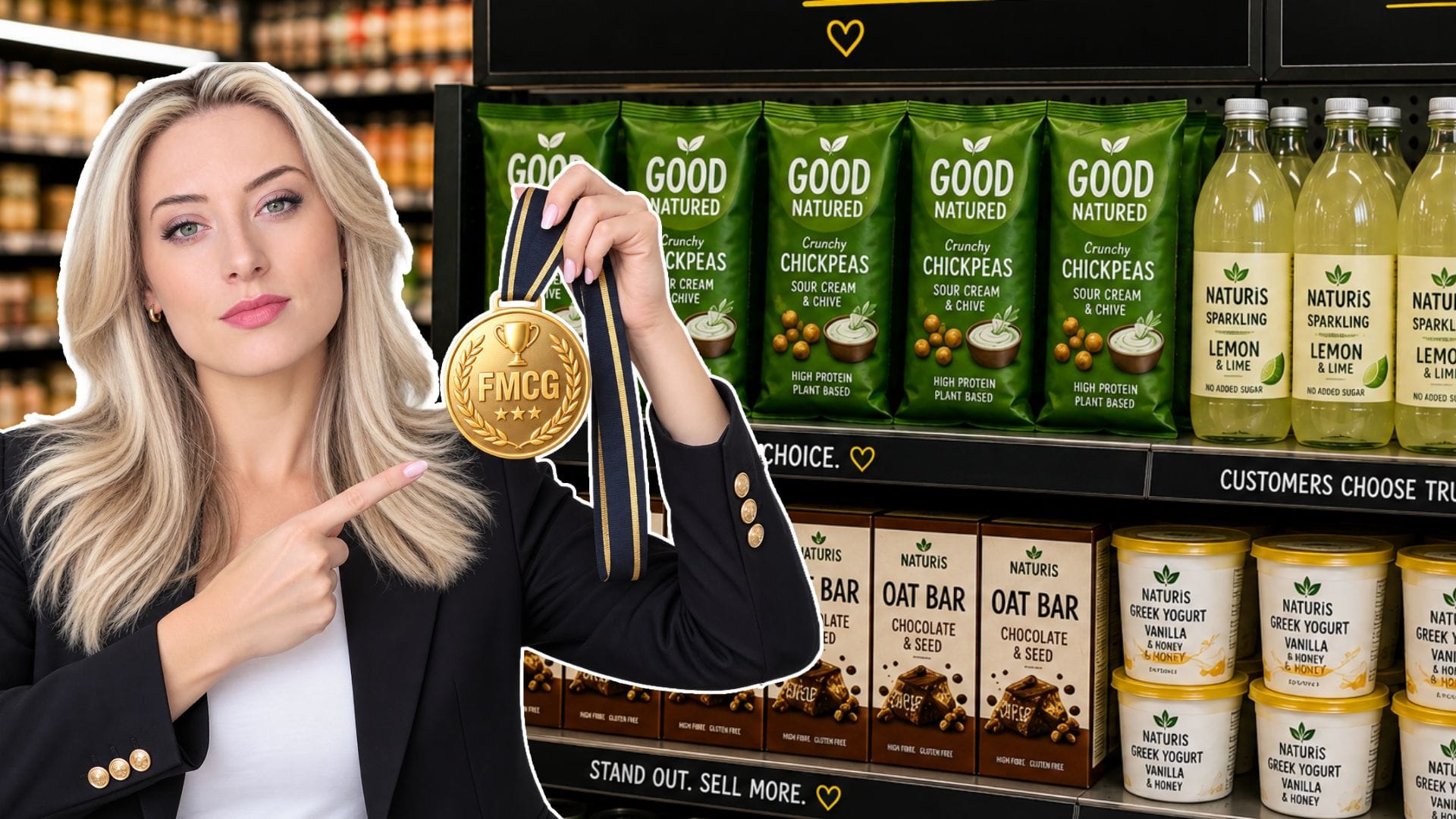

FMCG brand management is the work that turns a listing into a reorder. Getting on shelf is the part most brands plan for. Staying there is the part that decides whether the business grows.
Nielsen analysis reported by Marketing Week found that 76% of new FMCG launches fail in their first year. Two thirds never reach 10,000 unit sales. Most never hold a listing past twelve months.
If you are taking a brand through a range review this year, that is the number sitting behind your buyer’s questions.
What FMCG Brand Management Actually Means
Most definitions stop at logo guidelines and packaging. That describes brand administration, which is a smaller job with a smaller return.
Brand management is the commercial work of making one meaning stick with the right people, then holding it steady long enough to shift purchase behaviour at scale.
The job covers positioning against competitors, talking to retailers and shoppers at the same time and keeping every campaign, piece of content and PR moment pointed at one narrative. In a category with dozens of near-identical alternatives your margin for unclear messaging sits at zero.
The Positioning Failure Behind Most Delistings
The common failure sits upstream of the creative. Positioning that tries to appeal to everyone ends up mattering to nobody.
A premium chocolate brand competing on price. A health snack that buries its credentials behind lifestyle imagery. A craft brewery that sounds like every other craft brewery.
These are positioning failures rather than product failures.
Strong positioning needs a clear view on who you serve, what you stand for and why that matters commercially now. Everything downstream, from pack copy to media pitches, follows from it.
You might argue that positioning is a luxury and the immediate job is getting listed. The failure numbers answer that. Getting listed is the cheap part and the brands that lose their space are usually the ones a shopper could not describe.
Why Awareness Alone Will Not Hold a Listing
Equity in FMCG runs across awareness, trust and preference. Awareness gets you considered, trust gets you tried and preference gets you repurchased. Most brands fund the first and neglect the other two.
Earned Media as Proof for Two Audiences
Nielsen’s 2021 trust study found 88% of people trust recommendations from someone they know above any other channel. A feature in a consumer title or a review from a trusted journalist borrows some of that credibility in a way paid placement cannot.
For challenger brands on thin budgets, this is where PR pays for itself. Storytelling in PR means finding the angle that makes a journalist’s job easier rather than announcing news for its own sake.
Founder story, category disruption and mission-led development earn coverage because they carry something worth reporting.
Social Proof a Buyer Can See
The same trust figure explains why user-generated content moved from nice to have to commercial priority. Shoppers weigh a real customer above a polished brand post.
Useful UGC runs as a programme rather than a stream of reposts. Scaling UGC marketing means consistent, on-brand content from real consumers, produced often enough to hold up under a buyer’s scrutiny as well as a shopper’s.
In our experience the effect lands hardest on repeat purchase rather than on first trial, which is precisely where the failure data says brands lose.
Why Your D2C Presence Decides Your Retail Pitch
D2C gave FMCG brands direct data, fast message testing and a margin route that does not depend on a buyer saying yes. Holding one coherent brand across a supermarket shelf, an Amazon listing, a website and a social feed takes more discipline than any single channel ever demanded.
In our experience buyers check your social before they agree to a meeting. They look at reviews, at engagement and at whether the brand resembles something their shoppers already want.
That makes your D2C content strategy and your retail pitch the same argument delivered twice.
The stakes differ by category. A chilled challenger gets one shot at a range review that comes round twice a year, while an ambient household name can lose a facing and win it back next cycle.
Challengers therefore need the proof assembled before the meeting.
Social media marketing in FMCG works on different mechanics to B2B because the purchase cycle is short and emotional triggers do much of the work. Short-form video earns organic reach for the same reason. Brands absent from it cede ground to competitors who are not.
What FMCG Brand Management Should Measure
Measurement here runs past sales volume and follower counts. Share of voice, sentiment, earned media value, branded search volume and retailer feedback each tell you something the P&L reports far too late.
A buyer telling you footfall on your fixture has risen is among the most useful data you will ever receive.
Tracking need not cost much. Social listening, a quarterly media audit and honest conversations with retail partners will tell you more than most proprietary tools, provided somebody acts on what they say.
GEO for FMCG brands matters as AI search begins recommending products directly. Brands with clear topical authority and a consistent online identity get cited more often.
Frequently Asked Questions
What does an FMCG brand manager actually do day to day?
The work splits three ways. You hold the positioning steady, you generate proof through PR and consumer content and you read the signals that show whether either is landing. Most of the value sits in refusing the campaigns and listings that pull the brand off its position.
How do FMCG brands build brand equity?
Through sustained awareness, credible earned media, social proof from real consumers and a consistent presence in store and online. Brands that run PR, UGC and social alongside their retail strategy compound equity faster than those treating each in isolation.
What is the biggest challenge in managing an FMCG brand?
Holding consistent positioning across several channels while consumer preference shifts underneath you. Brands that lose messaging discipline, even briefly, struggle to recover their position in a crowded category.
How important is social media for FMCG brand management?
It shapes buyer confidence as much as consumer preference. A consistent social presence signals brand health to both audiences and has become a reference point before range review meetings.
FMCG brand management is a continuous commercial discipline rather than a project. It connects your product to the right people through the right channels with one consistent message. The payoff shows up in reorders rather than in launches.
We build the buyer-facing case and the shopper-facing one from the same material, which is why our PR, UGC and social work sits in one plan rather than three.
Book an FMCG Brand Audit and we will map your positioning, your earned coverage and your buyer-facing proof against your next range review.