


Black Friday falls on 27 November 2026. If your business sells nothing that anybody discounts, the sensible assumption is that this belongs to somebody else. The auction says otherwise.
This piece is for the B2B and professional services firms that have quietly decided the whole thing passes them by. It does not. It reprices the attention market you buy in, for roughly four weeks, whether you run a promotion or not.
What follows is the evidence for that claim and three defensible positions you can take.
What November Does to Your Costs
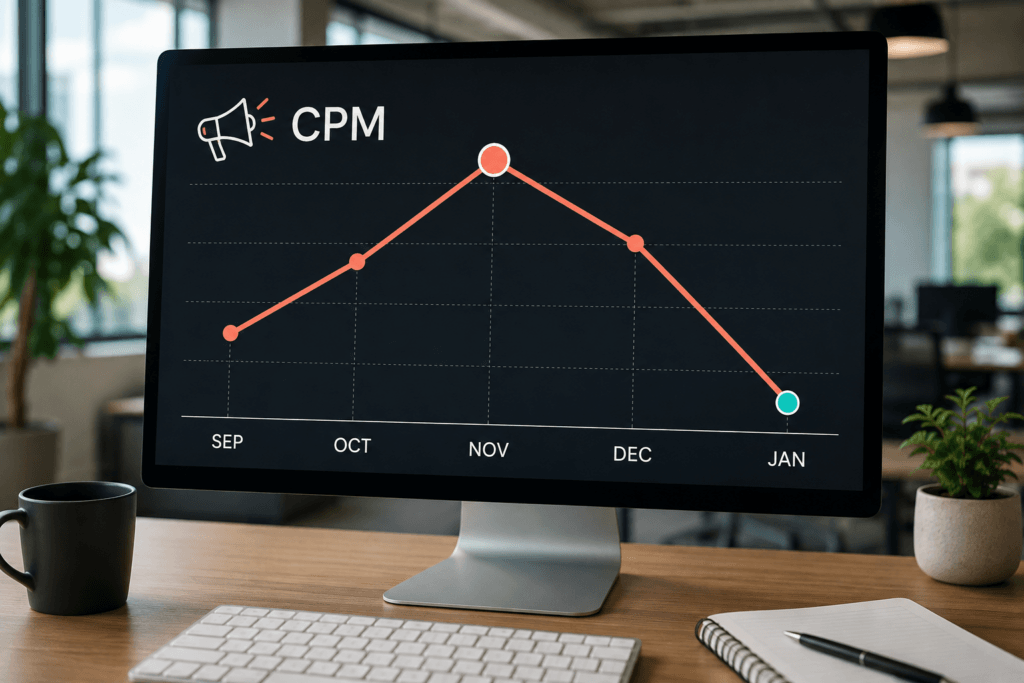
The paid effect is well documented. Gupta Media’s tracking of social ad rates found that Cyber Monday 2024 was the single most expensive day of the year on Meta at a CPM of $17.70, some 138% above Meta’s annualised average of $7.43. Black Friday ranked second at $16.85.
The week containing Black Friday was the most expensive week of the entire year, averaging $13.42. Holiday competition lifts seasonal CPM rates by as much as 66%.
One correction to the received wisdom: this effect shows up in impression costs rather than uniformly in click costs. Strike Social found Instagram CPM rising modestly through the period while its CPC actually fell. If you buy on a CPM basis in November, you subsidise a retail auction you never entered.
The Email Claim Worth Checking
The standard version of this argument says inboxes flood and open rates collapse. Half of that survives contact with the data.
Volume does rise. Sinch recorded a 32% year-on-year increase in November email volume in 2025, peaking during Cyber Week.
Engagement is a different story. Omnisend found that despite the extra volume, Black Friday emails still achieved a 13% click-through rate and Cyber Monday emails a 15% open rate, slightly ahead of the previous year. Retail engagement held up.
Our view, flagged as our view: plan for a fuller inbox rather than a collapse in opens. Nobody has published reliable B2B-specific November open rate data. The only trustworthy number sits in your own account.
A serious email marketing strategy earns its place here, because the brands that already segment properly have far less to fear from a crowded month.
The Accidental Opt-Out
Here is the behaviour worth naming. Most B2B and professional services brands never decide to skip Black Friday. They simply never discuss it, then wonder in December why November underperformed and conclude the market was slow.
Deliberate absence and absence by omission look identical on a calendar. Only one of them moved the money. Spending your November budget into an inflated auction produces a diminished result at full price.
Three Positions for Black Friday B2B Marketing
Three positions hold up. The right one depends on your budget, your sales cycle and how honest you are willing to be about your content.
Go Quiet on Purpose
Pull paid spend across the expensive fortnight, reduce publishing frequency and move the money.
Where you move it matters more than most guides admit. Triple Whale’s data has CPMs peaking at $25.22 in November 2025 and falling to a thirteen-month low of $15.74 by January 2026. Early December is cheaper than Cyber Week, though January is where the money actually goes furthest.
The trade-off is momentum. If your sales cycle is short, a quiet month costs you. If it runs to months, the gap matters far less than the saving.
Say the Opposite Thing
Counter-programming works when the work is good enough to survive without an offer attached. LinkedIn’s B2B Institute puts the share of B2B buyers who are out of market at any given moment at 95%, which means November attention is worth earning even when nobody buys that week.
The trade-off is honesty. This position only pays when the content earns attention on its own terms. Most brands overrate theirs.
Storytelling in PR decides whether a counter-programming piece reads as a point of view or as corporate content in a quiet room.
Sell a Deadline Rather Than a Discount
B2B buyers respond to deadlines. They do not respond to twenty per cent off professional services, which reads as an admission that the original price was invented.
Build scarcity without discounting: cohort places closing on a fixed date, a rate held for contracts signed before January, a diagnostic offered to a set number of clients. This is the hardest of the three to execute and the one most often botched, usually because somebody decides on it on 24 November.
What to Do Before the End of October
Pick your position now. All three need budget and content decisions in advance. Nobody can invent them on 25 November.
Check three things in your own data: what your CPM and cost per acquisition did last November; when your email engagement actually moved, rather than when you assume it moved; and whether your pipeline stalls in the final week, because your sales team need that warning in October and not mid-month.
Treating the calendar as a commercial variable rather than a backdrop is what modern PR strategies are built to do, and it is the same discipline that underpins any serious B2B marketing strategy. If you want the wider context on how discovery itself is shifting, generative engine optimisation is worth reading alongside this.
Frequently Asked Questions
Should B2B companies do anything for Black Friday?
Not necessarily, though they should make a deliberate choice. Doing nothing by default and doing nothing by design look identical on the calendar and produce very different results, because only a planned decision redirects budget to a better window.
Does Black Friday affect B2B email marketing?
Volume rises sharply: Sinch recorded a 32% year-on-year increase in November email volume in 2025. The evidence that open rates collapse is weaker than commonly claimed, since Omnisend found retail engagement holding up during the same period. Check your own account rather than assuming.
When should B2B brands start planning their November marketing?
By the end of October. All three viable positions, going quiet, counter-programming and building genuine scarcity, need budget approval and content prepared in advance.
Is it worth pulling paid media spend during Black Friday?
For many B2B brands, yes. Meta CPMs peak in November and reach a thirteen-month low the following January. Moving budget out of the expensive fortnight often buys more from the same spend, provided your sales cycle can absorb the pause.
The Only Real Question About Your November
Black Friday B2B marketing is a repricing of the attention market that reaches your category whether or not you sell anything with a percentage off. The brands that handle it well are frequently the ones that sat it out, having decided to in October rather than diagnosed it in December.
What did your business decide about Black Friday, and when? If the honest answer is that it never came up, talk to us about your communications strategy while there is still time to change the plan.