
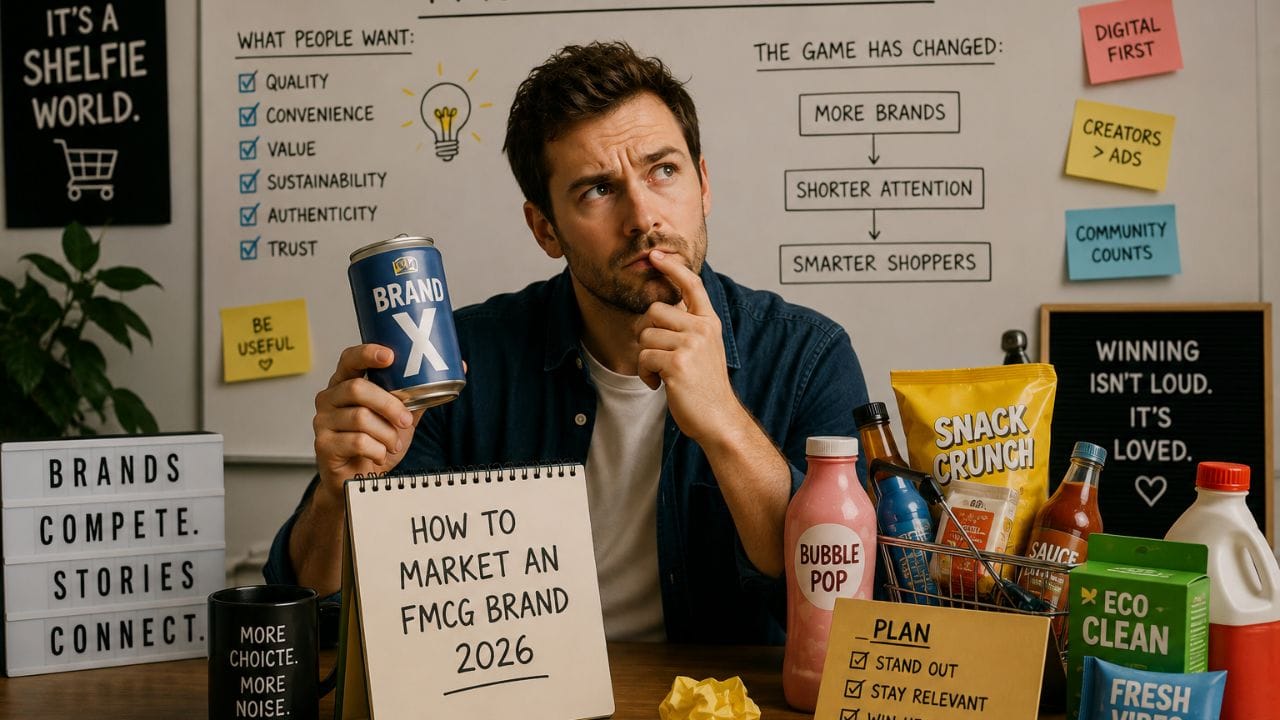

FMCG marketing has never been more competitive, or more rewarding for brands that get it right. Consumers make purchase decisions in seconds, media attention spans are shorter than ever and the brands winning shelf space – physical and digital – are those combining sharp PR with smart, data-led marketing. This is not a moment for guesswork.
What Is FMCG Marketing and Why Does It Demand a Different Approach?
FMCG marketing covers the strategies and tactics used to promote fast-moving consumer goods: the food, drinks, health and household products that consumers buy repeatedly, frequently and often on impulse. The category is brutally competitive. Margins are tight, switching costs are low and a new challenger brand can appear on shelves – or in a social feed – overnight.
That dynamic means FMCG brands cannot rely on brand awareness alone. They need a strategy that builds trust, drives trial and converts occasional buyers into loyal advocates. Understanding what FMCG is and what it means for your marketing is the essential starting point before you build any campaign.
Why Generic Marketing Fails FMCG Brands
Generic brand marketing – broad messaging, slow creative cycles, single-channel thinking – simply does not move product in 2026. FMCG consumers discover brands through social feeds, trust peer recommendations over advertising and expect brands to reflect their values on sustainability, health and community. If your comms strategy is not built around these realities, you are handing ground to competitors who are.
Building an FMCG Marketing Strategy That Actually Works
A high-performing FMCG marketing strategy in 2026 is not one thing. It is an integrated system where PR, social media, content, user-generated content and search all reinforce each other. Here is how the strongest brands are building that system right now.
Start With PR to Build Credibility at Scale
PR is the credibility engine of FMCG marketing. A feature in a national food title, a review from a respected consumer journalist or a well-placed brand story in a lifestyle publication does something paid advertising cannot: it tells consumers that an independent voice rates your product. That third-party validation shortens the distance between discovery and purchase.
The most effective FMCG brands treat PR as a long-term investment rather than a campaign bolt-on. As our piece on why storytelling in PR is more important than ever explores, the brands earning consistent media coverage are the ones with a genuine narrative, not just a product to sell.
Make Social Media Your Always-On Sales Channel
Social media marketing for FMCG brands is no longer optional. Instagram, TikTok and Pinterest are where consumers encounter new products, compare alternatives and seek social proof before making a purchase. The brands dominating these platforms share two things: they post consistently and they create content worth sharing.
Short-form video is the clearest opportunity right now. According to HubSpot’s 2025 State of Marketing report, short-form video delivers the highest return on investment of any social content format. For FMCG brands, that means product demos, recipe content, behind-the-scenes production footage and creator collaborations that feel native to the feed rather than lifted from a TV ad. Our breakdown of why brands cannot ignore short-form video covers exactly how to structure this approach.
Use UGC to Build Trust Where It Matters Most
User-generated content is one of the most powerful tools available to FMCG marketers. Consumers trust other consumers. When a real person shares their experience of your product – whether through an unboxing, a recipe post or a glowing review – it carries more weight than any brand-produced creative.
The commercial case for UGC in FMCG is well established. Research shows that UGC can drive conversion rate uplifts significantly above paid media benchmarks. Our analysis of how UGC marketing ROI can drive growth by 161% lays out the evidence in detail. The key is building a systematic approach to collecting, curating and deploying UGC across every touchpoint, from product pages to paid social ads.
Optimise for Generative Search – GEO Is Not Optional in 2026
Most FMCG brands have invested in traditional SEO. Far fewer have prepared for generative engine optimisation (GEO), the practice of structuring content so that AI-powered search tools like Google’s AI Overviews and ChatGPT cite your brand in their responses.
This matters enormously for FMCG. When a consumer asks an AI assistant ‘what is the healthiest snack bar?’ or ‘which oat milk brand is best?’, the brand that appears in the answer has a significant advantage. That answer is shaped by the quality, authority and structure of your online content. Our guide on why GEO is key for FMCG, B2B and D2C brands explains the mechanics in full. If you are not yet familiar with the concept, start with what GEO is and how it works.
Influencer and Creator Partnerships That Drive Real Results
Influencer marketing remains a core pillar of FMCG marketing, but the rules have shifted. Mega-influencer deals with millions of followers are increasingly being replaced by targeted micro and nano-creator partnerships – smaller audiences, higher trust and often a fraction of the cost. The engagement data consistently supports this direction.
The critical factor is fit. A creator with 15,000 engaged followers in the health food space will outperform a celebrity endorsement for a challenger brand every time, provided the partnership feels authentic. Our guide to choosing the right influencers in PR walks through how to assess creator alignment before you commit budget.
How to Measure FMCG Marketing Performance
Marketing that cannot be measured cannot be improved. FMCG brands should track performance across four key dimensions: brand awareness metrics (reach, share of voice, media coverage volume), engagement metrics (social interactions, UGC volume, email open rates), conversion metrics (trial rates, online sales, repeat purchase rate) and earned media value.
The most successful brands set these benchmarks before any campaign launches, not after. They use integrated reporting to understand how each channel contributes to the overall commercial result, rather than measuring each in isolation. Our piece on measuring the impact of UGC on your marketing strategy offers a practical framework that translates across wider FMCG measurement challenges.
Frequently Asked Questions About FMCG Marketing
What makes FMCG marketing different to other marketing?
FMCG marketing operates at speed and scale, with high purchase frequency, low brand loyalty and intense competition for consumer attention. Campaigns need to be visually compelling, emotionally resonant and distributed across multiple channels simultaneously to drive both trial and repeat purchase.
Which social media channels work best for FMCG brands?
Instagram and TikTok currently deliver the strongest results for FMCG brands targeting consumers directly, particularly for food, drink and health products. However, the right channel depends on your audience demographics and product category. A strategy built on one platform is always fragile; the best FMCG brands maintain a presence across several.
How important is UGC for FMCG marketing in 2026?
Extremely. Consumer trust in brand-produced content has declined sharply while trust in peer recommendations has risen. UGC fills that gap authentically and cost-effectively. Brands that build systematic UGC programmes consistently report higher conversion rates and stronger long-term brand affinity.
What is GEO and why should FMCG brands care?
GEO stands for generative engine optimisation. It is the practice of structuring your content and digital presence so that AI-powered search tools surface your brand in their responses. As AI search adoption grows, appearing in these answers represents a significant new source of consumer discovery for FMCG brands. Nifty Communications are a PR and marketing agency that combines both disciplines under one roof to help FMCG brands scale faster. If you are ready to build an integrated FMCG marketing strategy that drives real commercial results, get in touch with the Nifty team.