
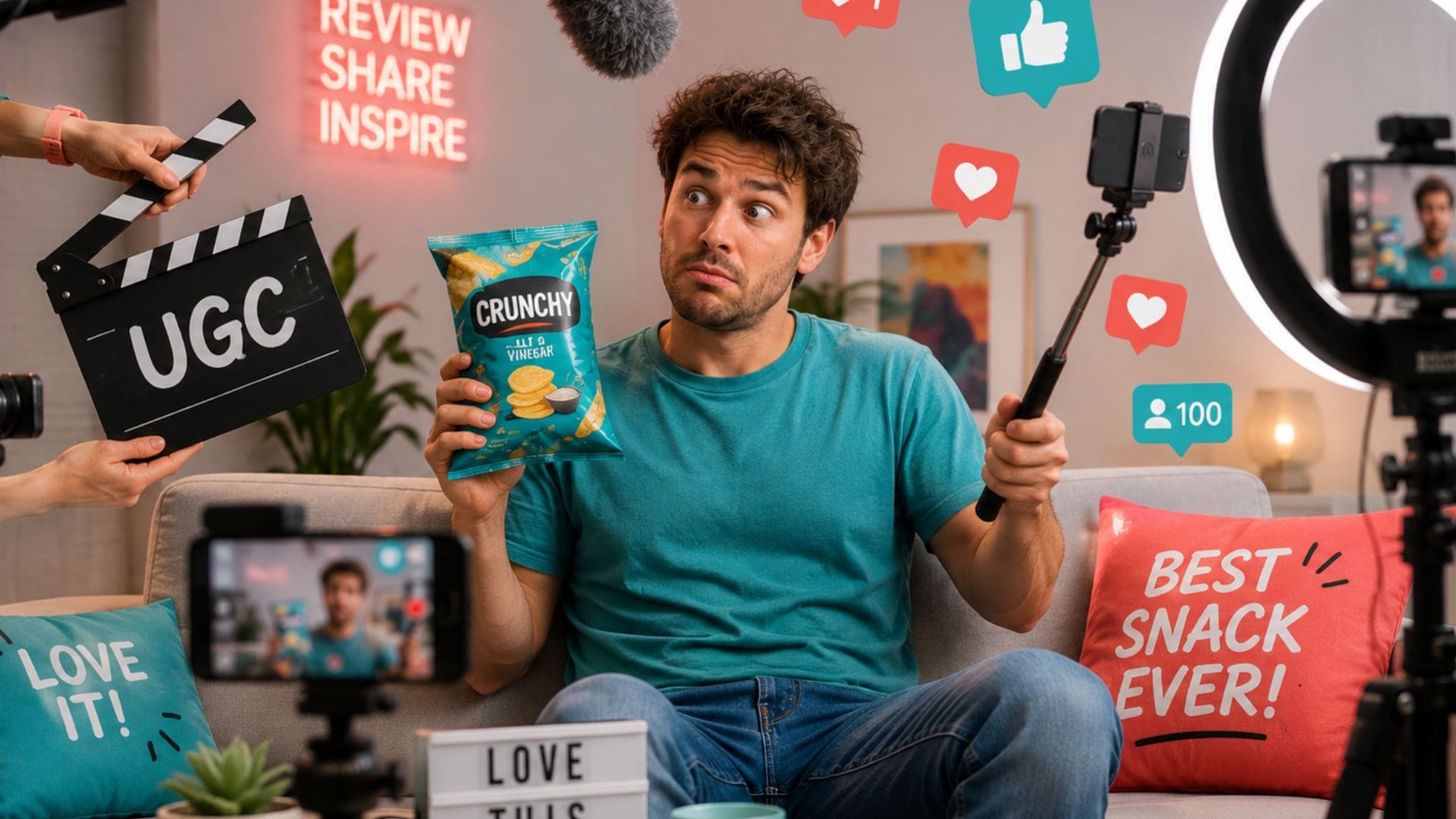

UGC marketing works. The number everybody quotes about it describes something narrower than most brands think.
Yotpo analysed 200,000 stores and 163 million orders and found that shoppers who interacted with user-generated content converted 161% more than shoppers who did not. The same study found only around 30% of site visitors ever interact with it.
If you are collecting customer content and still seeing flat conversion, that second figure is the one to work on.
What UGC Marketing Actually Means
User-generated content is any content made by real people rather than brands. Reviews, unboxing videos, social posts, photos, testimonials.
The principle underneath is simple. People trust other people more than they trust advertising. A customer showing your product in their kitchen carries weight no studio shoot replicates, which is the power of UGC in building brand trust.
The commercial logic is equally plain. Producing original content at scale is slow and expensive, while curating content your audience already makes lets your output grow without your production budget growing alongside it.
Is UGC Marketing the Same as Influencer Marketing?
Not quite, though the two overlap. Influencer marketing pays someone with an established audience to promote your product whether or not they use it.
UGC marketing is rooted in content from actual users, which may include micro-creators but is not defined by follower counts or payment. Authenticity is the mechanism. The moment content feels commissioned, that mechanism weakens.
The Number Most Brands Misread
The 161% figure gets repeated as proof that adding UGC lifts conversion by 161%. It does not say that.
Yotpo compared shoppers who engaged with UGC against shoppers who did not. People who scroll to the reviews are already further down the funnel. Part of that gap reflects intent rather than persuasion.
The useful reading sits in the other number. If only 30% of visitors ever reach your customer content, the lever is placement and distribution rather than collection volume.
You might argue that more content solves this anyway. It rarely does, because content nobody encounters converts nobody.
Move the UGC above the fold, into the ad, into the email and onto the category page before you commission another round of it.
How to Build a UGC Marketing Strategy That Scales
Most brands wait for UGC to happen. That produces inconsistent volume and no control over quality.
Make It Easy to Create
Ask at the moment the customer feels something. Immediately after delivery, after a positive review or after a specific product experience.
A prompt in a post-purchase email, a hashtag on the pack or a short ask in your captions all lift the volume you receive. Campaigns that inspire submissions need to feel rewarding rather than clever, whether through recognition, a discount or a feature on your channels.
Curate Hard and Repurpose Everywhere
Volume is not the goal. Selecting the wrong content damages trust rather than building it. Look for content showing the product in context with real emotion or a real outcome.
One customer video that performs on Instagram can be cut for a paid ad, embedded in an email, placed on the product page and used in a PR pitch. That repurposing is where most of the value sits and where most brands stop.
Our Doisy & Dam work shows the effect at full stretch. The Really Good Egg launch lifted overall engagement by 654% and reach by 365%, with Facebook reach up 2,600%. The product became the 14th highest selling chocolate brand on Amazon that Easter before selling out and forcing a restock.
Rights, Permissions and UGC Marketing Compliance
Most brands overlook this until it becomes a problem. A comment saying ‘feel free to share this’ is not a rights agreement.
Build permission into the request itself. A direct message, a reply with a specific phrase or a short form all work. All of them take less time than a takedown.
The legal aspects of UGC matter most once content crosses into paid advertising, where ASA and CAP rules apply in the UK and FTC guidance applies in the United States.
UGC Marketing Versus Paid Ads
The honest answer is that the two belong together. UGC builds trust and organic reach while paid buys distribution. Each makes the other work harder.
UGC-led creative outperforms brand-produced creative on click-through and conversion, particularly on Meta. People scroll past ads that look like ads and stop for content that looks like content.
This matters most in fast-moving categories, where purchase decisions are frequent and social proof carries the weight. Social media marketing in the FMCG industry sits directly on top of a working UGC programme.
Measuring UGC Marketing Performance
Shares and saves are a start. The indicators that matter sit downstream.
Conversion rate on product pages featuring UGC against those without it. Cost per acquisition on paid campaigns using UGC creative against brand creative. Time on page where customer video appears.
Measuring the impact properly means setting baselines before a campaign launches. Without that baseline you are comparing numbers with no context, which tells you very little.
[IMAGE 3: Dashboard comparing conversion rate, organic reach and cost per acquisition for UGC against brand creative]
Frequently Asked Questions
What types of content count as UGC?
Any content created by real customers rather than the brand. Photos, videos, reviews, social posts, unboxing content and testimonials all qualify. The defining feature is that the creator is not acting in an official brand capacity.
Do I need to pay customers to create UGC?
Payment is not required and can reduce the perceived authenticity of the content. Recognition, features on your channels or light incentives such as discounts drive strong volume on their own.
Can small brands benefit from UGC marketing?
Yes, often more sharply than large ones. Smaller communities tend to be more engaged and more willing to share content that feels personal. The approach scales up as the brand grows.
How does UGC affect SEO?
UGC contributes through fresh content on product pages, long-tail language that customers actually use and engagement signals that search engines factor into rankings. Using UGC for SEO covers the mechanics.
UGC marketing pays when it runs as a system rather than a habit. Collect it deliberately, clear the rights, curate hard and then put it where the other 70% of your visitors will actually see it.
We build UGC programmes that connect content strategy, PR and paid media, which is how the Really Good Egg went from a launch with no paid budget to a restock.
Book a UGC Programme Review and we will show you where your customer content is sitting and how many people ever reach it.