

A smart social media channel strategy should follow your audience. Most brands follow the industry conversation instead. That gap is where budget goes to die.
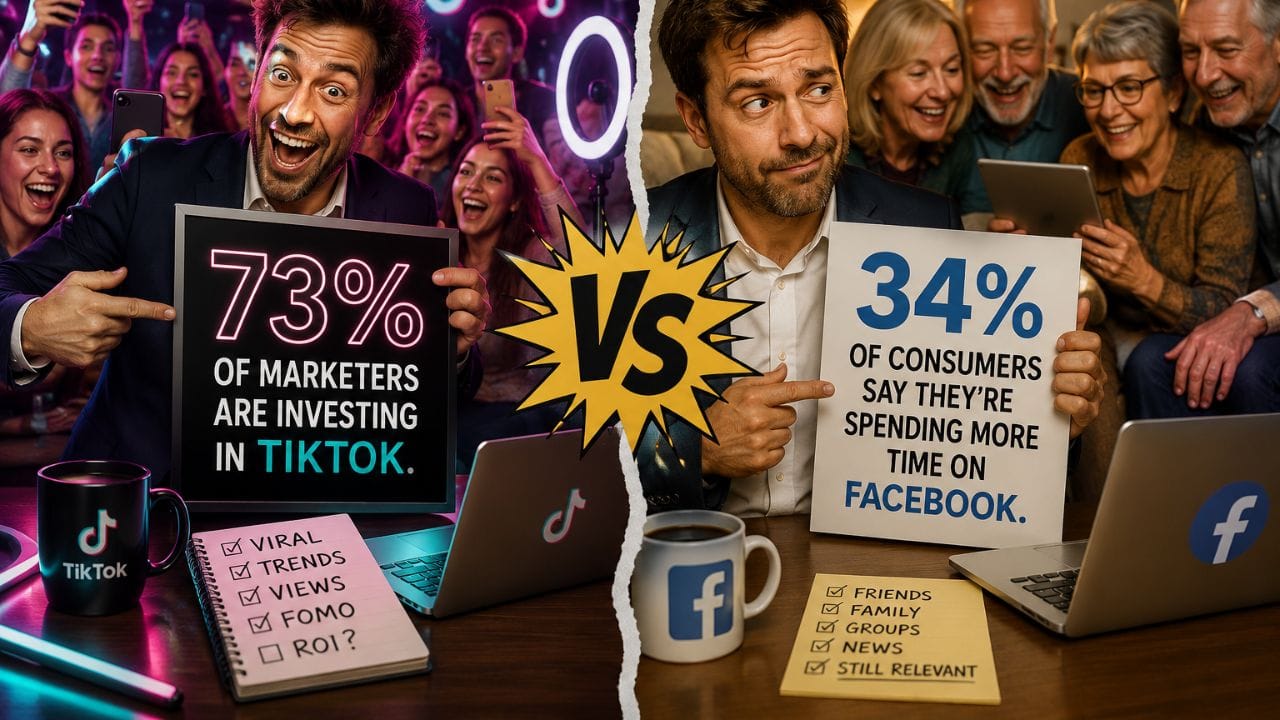
Seventy-three per cent of marketers are piling resource into TikTok. Meanwhile, 34% of consumers say they are spending more time on Facebook than they were two years ago. Those two numbers do not belong to different planets. They belong to the same strategy conversation and the fact that most brands never reconcile them is a genuine commercial problem.
This is not a critique of TikTok. It is a critique of the decision-making process that puts brands on platforms because those platforms are being talked about at conferences, not because the data supports it.
The Marketer’s Echo Chamber
Why social media channel strategy keeps getting this wrong
Marketers read the same trade press. They attend the same events. They share the same LinkedIn posts celebrating the same campaign examples. The result is a professional culture that mistakes industry attention for audience attention.
Legacy platforms are not dead. They are just not cool to talk about. Facebook has over three billion monthly active users. YouTube processes more than a billion hours of video every day. Email open rates in B2B still outperform most paid social click-through rates by a considerable margin. None of this is secret information. It simply does not generate conference keynotes.
The standout campaigns of recent years did not succeed by being on the trendiest platform. They succeeded by meeting audiences where those audiences already were. That is not a radical idea. It is the oldest principle in marketing, consistently abandoned the moment a new platform generates enough industry buzz.
Where Your Audience Actually Is
The numbers are worth sitting with. Facebook still dominates time spent among the 35-plus demographic, which is the primary purchase decision-maker in most FMCG and B2B categories. YouTube is the default destination for product research and purchase validation, with Google’s own data showing that over 50% of shoppers say they used YouTube to inform a purchase decision. WhatsApp groups and private communities are growing fast as spaces where genuine brand preference forms, away from the algorithm.
TikTok has real reach. The audience skews younger, the intent is entertainment and dwell time does not automatically translate to purchase consideration. That does not make it wrong for every brand. It makes it wrong for brands whose customers are not primarily 18 to 24-year-olds with a browsing mindset.
This is also, increasingly, a discoverability question. As AI search evolves and Google AI Overviews reshape how people find brands, the platforms where you publish authoritative, well-structured content are now part of your search presence. Understanding what GEO means for your brand and how generative search engine optimisation works is no longer optional context. It is directly relevant to where you invest your content effort.
The Content and Channel Connection
Choosing the right channel still fails you if the content is wrong. Human-led, authentic content outperforms produced, polished, brand-voice-only content on almost every platform measured. This holds across Facebook, YouTube, LinkedIn and TikTok alike.
The risk of a poor social media channel strategy compounds when brands use AI-generated content to populate every channel simultaneously. You are not scaling smart content. You are scaling the wrong approach at speed. Channel focus and content quality are inseparable decisions. Choosing fewer channels and producing better content for each one consistently outperforms the spray-and-pray model.
The UGC and EGC Angle
Brands that get channel strategy right are also thinking carefully about who creates their content. User-generated content and employee-generated content perform differently across platforms, and a smart strategy accounts for that from the outset.
UGC from genuine customers lands differently on Facebook community pages than it does on TikTok. EGC from subject-matter experts performs better on LinkedIn than it does on Instagram. The platform shapes what credibility looks like. Understanding whether scaling UGC marketing can make a real commercial difference is a useful starting point for thinking about creator content as a channel-specific tool, not a one-size-fits-all asset.
The power of UGC in building brand trust also varies significantly by platform. Trust signals on YouTube look different to trust signals on Instagram. Your strategy should reflect that.
Platform by Platform: A Practical Guide
LinkedIn works for B2B thought leadership, executive positioning and pipeline generation. Long-form posts, original analysis and points of view that challenge the consensus generate the engagement that drives follower growth and inbound conversations.
Facebook works for community building, FMCG audience reach and lower-funnel paid social. The organic reach is limited but the targeting depth for paid campaigns remains the strongest in social advertising. Do not write it off because it is unfashionable.
YouTube
YouTube works for long-form product education, tutorials and purchase validation content. If a customer is researching your category seriously, YouTube is where they are likely doing it. Brands that treat short-form video as a replacement for YouTube rather than a complement to it are leaving a significant slice of the consideration funnel unaddressed.
Instagram works for visual brand storytelling, product aesthetics and influencer partnerships. Choosing the right influencers matters more on Instagram than almost any other platform because the audience relationship is built on perceived authenticity.
TikTok
TikTok works if your audience is genuinely there and you can commit to consistent, native-feeling content production. Posting twice a month will not move anything. If the resource is not available to do it properly, do not do it at all.
Email sits above all of them as the one channel you own outright. Algorithm changes, platform policy shifts and account suspensions cannot take your email list from you. Building it alongside your social presence is not optional.
How to Audit and Reallocate Your Channel Budget
A practical social media channel strategy framework
Pull your own audience data first. Platform analytics, CRM demographics and website traffic sources tell you more about where your audience actually is than any industry report. Cross-reference your findings against published platform consumption data for your sector.
Stop relying on gut feeling and stop copying competitors. Competitors copying each other on the same channels is how entire categories end up in the same echo chamber simultaneously. If the data supports a different allocation, make the move.
Ruthlessly reallocate toward where your audience is. Set clear measurement criteria before you invest. Know what you are optimising for, whether that is reach, consideration, conversion or retention and choose channels accordingly. Review quarterly. Platform behaviour shifts faster than annual planning cycles can accommodate.
Frequently Asked Questions
What is a social media channel strategy?
A social media channel strategy is a deliberate plan that defines which platforms a brand invests in, why it invests in them and what it aims to achieve on each one. It should be built on audience data and commercial objectives, not platform trends.
How do I choose the right social media channels for my brand?
Start with your audience demographics and where they actually spend time, not where the industry conversation is focused. Cross-reference platform data with your own analytics, then choose the smallest number of channels you can commit to producing quality content for consistently.
Is Facebook still worth investing in for marketing?
Yes, particularly for FMCG brands and audiences aged 35 and above. Facebook still generates more time-on-platform for this demographic than most alternatives and offers the strongest paid social targeting depth in the market.
How often should I review my channel strategy?
At minimum, quarterly. Platform algorithm changes, audience behaviour shifts and new data from your own campaigns can all signal that a reallocation is needed. Annual planning cycles alone are too slow to keep pace with how social platforms evolve. – A social media channel strategy built on data rather than industry FOMO is one of the most commercially valuable decisions a brand can make. Nifty helps FMCG and B2B brands build exactly that. If you are ready to stop following the conversation and start following your audience, explore how Nifty’s marketing and PR services work and let’s talk about where your budget should actually be going.