
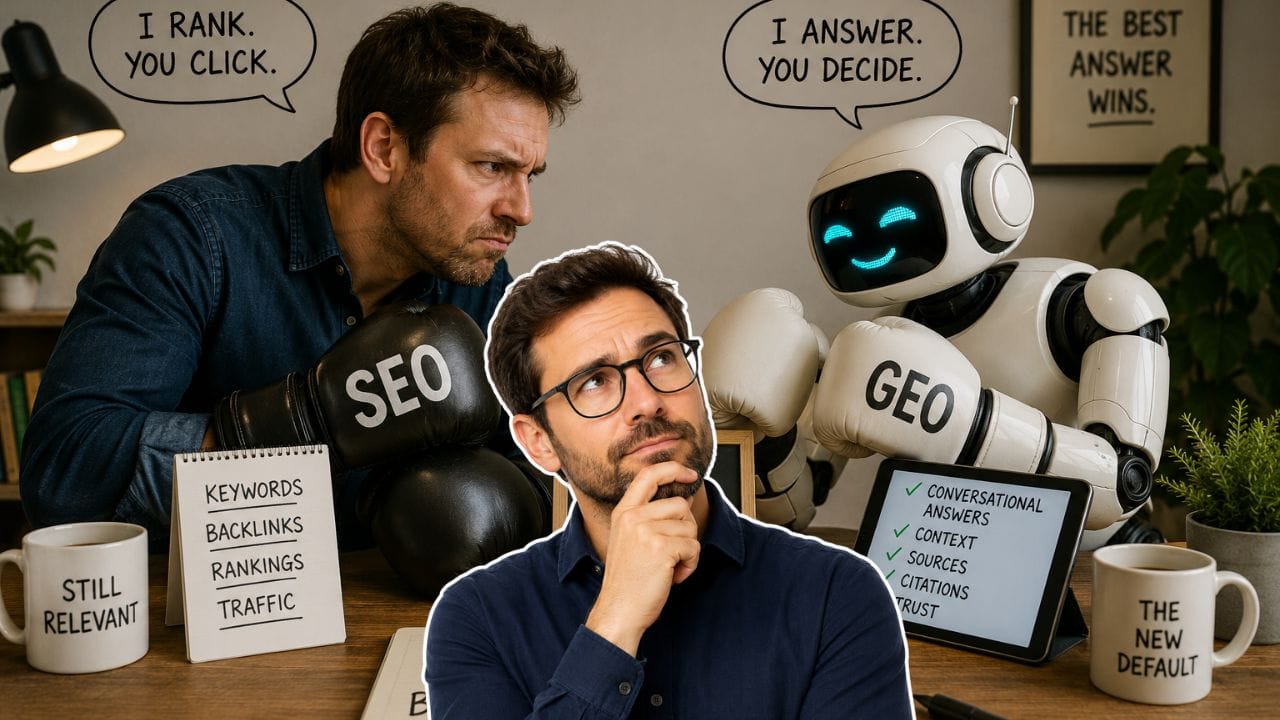

GEO vs SEO is the defining strategic question for any brand that depends on search visibility right now. For decades, the goal was simple: rank on page one. Get the click. Drive the traffic. That model is changing faster than most marketing teams have noticed.
Generative Engine Optimisation – GEO – describes the practice of making your content visible and citable inside AI-generated answers. Tools like Google’s AI Overviews, ChatGPT Search and Perplexity are now answering millions of queries directly, without sending users to a website at all. If your brand is not appearing in those answers, you are losing reach you cannot see on a standard analytics dashboard.
What Is the Difference Between GEO and SEO?
Traditional SEO optimises for search engine crawlers and ranking algorithms. The goal is to earn a position in the organic results so that a human searcher clicks through to your page. Success is measured in rankings, organic sessions and click-through rates.
GEO operates on different logic entirely. AI models do not rank pages in a list and wait for a click. They synthesise information from multiple sources and generate a single, confident answer. Your content either contributes to that answer or it does not. There is no page two.
The critical distinction is this: SEO earns you a position in a list. GEO earns you a citation inside an answer. Both matter, but they require different approaches to content, authority and structure.
To understand the technical foundations of GEO in more depth, the Nifty team has covered what GEO is and how it works in detail, along with a breakdown of how GEO actually works under the hood.
How GEO vs SEO Affects Your Content Strategy
Writing for a Ranking Algorithm vs Writing for an AI Model
SEO content has historically been structured to satisfy keyword intent and earn backlinks. Headers, meta tags, internal linking and page speed all feed into how an algorithm evaluates relevance and authority. These signals still matter.
However, AI models assess content differently. They look for clarity, factual accuracy, source credibility and how well a piece of content directly answers a specific question. Research from Princeton, Georgia Tech and other institutions published in 2023 found that citing authoritative sources, using quotations and providing statistical evidence significantly increased the likelihood of content being surfaced in AI-generated responses.
The practical implication is that thin content, vague opinion pieces and keyword-stuffed pages are becoming invisible twice over. They lose ground in traditional rankings and they fail the credibility threshold that AI models apply when selecting sources to cite.
The Role of Brand Authority in GEO
One area where the two disciplines converge is authority. SEO has always rewarded brands that build genuine topical authority through consistent, expert-led content. GEO amplifies this requirement considerably.
AI models weight recognisable, frequently cited sources more heavily. This means that brands investing in storytelling in PR, thought leadership and earned media are building the exact kind of credibility signals that GEO rewards. A strong PR strategy is no longer just about column inches. It directly feeds your visibility in AI-generated answers.
This is precisely why modern PR strategies have shifted to treat every piece of earned coverage as a structured authority signal, not just a brand awareness moment.
Does SEO Still Matter in an AI-First World?
Yes. Emphatically. SEO is not dead, and any suggestion otherwise misreads how search behaviour works in 2025. According to SparkToro’s 2024 Zero-Click Search Study, a significant proportion of searches still result in clicks to websites, particularly for complex, commercial or transactional queries. AI Overviews tend to dominate informational queries, while product pages, comparison content and local results continue to drive traditional organic traffic.
The smarter framing is that SEO and GEO are complementary, not competing. Brands that treat them as an either/or choice will underinvest in one at exactly the wrong moment.
GEO-ready content tends to be better SEO content anyway. Structured, authoritative, clearly written copy that answers specific questions directly will outperform vague, over-optimised content in both traditional rankings and AI answer panels. The disciplines reinforce each other when approached correctly.
For brands in the FMCG, B2B and D2C space, the Nifty team has explored specifically why GEO is key for FMCG, B2B and D2C brands and what that means in practice.
How to Optimise for Both GEO and SEO Simultaneously
Build Content That Answers Questions Directly
Structure every piece of content around a specific question. Lead with the answer. Provide the evidence. AI models are trained to surface content that resolves a query efficiently, so burying your key point three paragraphs down is a structural error that costs you in both channels.
Invest in Off-Page Authority
Backlinks remain a core SEO signal. For GEO, the equivalent is citation frequency across the web. Brands that appear in credible third-party sources, industry publications and PR placements are more likely to be cited by AI models. The importance of off-page SEO in digital marketing applies directly to your GEO strategy as well.
Structure Your Content for AI Parsing
Use clear H2 and H3 headings. Keep paragraphs concise. Include data, specific claims and named sources. These structural choices make it easier for AI models to extract and attribute information accurately. Schema markup, FAQ sections and clearly defined entities all support this process.
If you are at the beginning of this journey, the Nifty resource on the importance of Generative Engine Optimisation is a practical starting point.
Is Your Brand Ready for the GEO Shift?
Most brands are not. Not because they lack the content, but because their existing content was built for a different kind of search. Pages optimised purely for keyword density, without clear factual claims or structured answers, will not be selected as AI sources regardless of their traditional ranking position.
The good news is that the gap between where most brands are and where they need to be is closable. It requires an audit of existing content, a restructured editorial approach and a PR strategy that treats every placement as a credibility asset. The Nifty team has built a practical guide to help brands assess whether they are prepared for GEO right now.
Frequently Asked Questions
Is GEO replacing SEO?
No. GEO and SEO serve different but overlapping purposes. SEO drives clicks from traditional search results, which remain significant for commercial and transactional queries. GEO ensures your brand is cited inside AI-generated answers for informational and research-led queries. Brands need both.
What type of content performs best in AI-generated answers?
Content that answers a specific question directly, cites credible sources, includes data and is written with clear structure performs best. AI models prioritise clarity and authority over keyword frequency.
How do I know if my content is being cited by AI tools?
Tools such as Perplexity, ChatGPT Search and Google AI Overviews can be queried directly for your brand name or target topics. You can also use emerging GEO tracking platforms, several of which launched in 2024 and 2025, to monitor AI citation frequency across major models. The GEO vs SEO question does not have a winner. It has a direction. Search is moving towards AI-generated answers and the brands that adapt their content strategy now will own far more visibility than those waiting to see how it plays out. Get in touch with the Nifty Communications team to find out how we build content strategies that perform in both traditional search and the AI answer layer.