
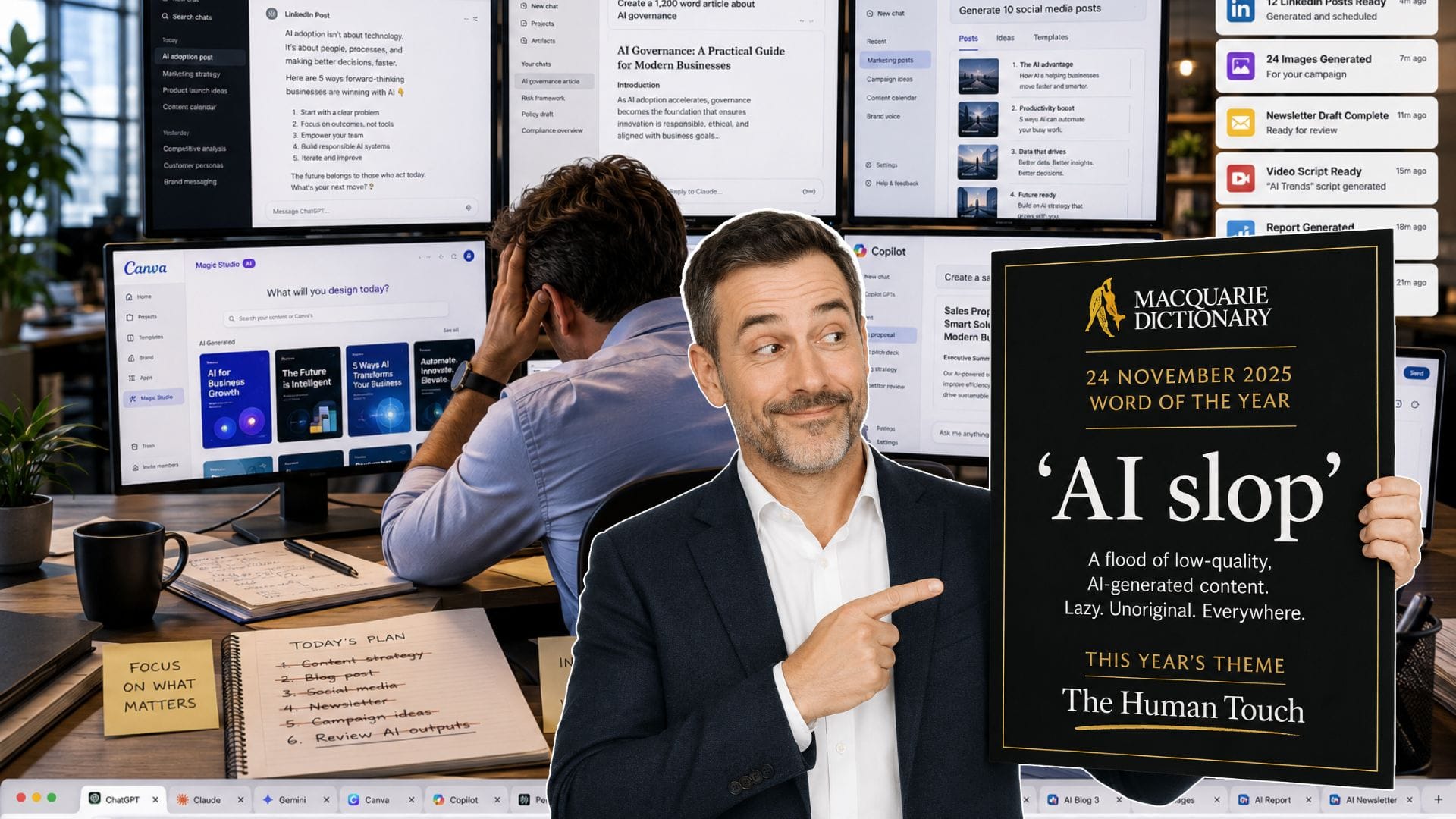

AI content marketing is accelerating faster than most brands know what to do with and the results are starting to show. Not in a good way.
Walk the floor at MAD//Fest and you hear the same conversation everywhere. Marketers know they need to move faster. They know AI gives them leverage. The problem is that somewhere between the prompt and the publish button, the brand disappears. What comes out the other end is content that technically exists but says nothing to anyone.
That tension is what this piece is about.
AI Content Marketing and the ‘AI Slop’ Problem
‘AI slop’ was not a phrase that needed explaining by mid-2025. Everyone in a marketing role knew exactly what it meant.
It is generic content. Hollow, interchangeable, confidently written and utterly forgettable. Blog posts that open with rhetorical questions. LinkedIn updates that celebrate being ‘passionate about driving growth’. Social captions that sound like a brand voice template rather than an actual brand. The output of a machine asked to produce content before anyone decided what they actually wanted to say.
The tell is usually tone. Smooth, frictionless and slightly off. Real people don’t write like that. Real brands don’t either. Your audience has spent enough time online to recognise it within two sentences, even if they couldn’t explain exactly why it felt wrong.
Why AI Slop Is Everywhere Right Now
The volume incentive is obvious. AI can produce in minutes what used to take hours. For stretched teams under pressure to feed content calendars, the temptation to hit publish without interrogating the output is enormous. Add to that the reality that many brands never had a properly defined voice in the first place, and the conditions for slop are perfect.
The result is a feed full of content that all sounds vaguely like the same entity wrote it.
Why This Is Quietly Damaging Brands
The damage does not happen in one visible moment. There is no single post that kills a brand’s credibility. It erodes. Slowly, consistently, imperceptibly. Until the audience has simply stopped paying attention.
Engagement drops and teams assume the algorithm changed. Reach declines and the response is to post more. More volume means more slop, and the cycle accelerates. According to Edelman’s 2025 Trust Barometer, trust in brands is declining while trust in ‘people like me’ continues to rise. That shift matters enormously for how content needs to function in 2026.
Brands that sound like everyone else do not just fail to grow. They actively lose ground to the ones who have found their voice and are prepared to use it.
The Case for AI, Done Properly
Here is where a confident, blanket rejection of AI falls apart.
The agencies and brands using AI well are genuinely moving faster. Research that used to take a full day takes an hour. Structural frameworks for long-form content get built in minutes. Ideation sessions that previously required a room full of people can start with a well-crafted brief fed into a model that surfaces angles you hadn’t considered.
That is real, legitimate value. The brands winning with AI content marketing in 2026 are not the ones producing the most output. They are the ones using AI as an accelerant for human thinking, not a replacement for it. Speed to first draft, yes. Speed to publish without a human shaping the final product, no.
At Nifty, we use AI to sharpen the process, because our services are built around delivering results, not just activity. The difference is that a human is always in the room deciding whether something is actually worth saying.
Where AI Falls Short Every Single Time
Ask an AI to write a founder story. It will produce something that follows the correct structure. It will not produce the thing the founder said in a podcast three years ago that went unexpectedly viral, or the product failure that nearly closed the business, or the observation about a cultural moment that only made sense because someone in the team had actually lived through it.
That is the gap. Lived experience. A genuine point of view on a contested topic. Humour that is genuinely funny rather than technically inoffensive. Cultural references that are precise enough to be meaningful rather than broad enough to offend no one.
Brand voice, when it is properly built, takes years. It is made of decisions: what to say, what to refuse to say, what to sound like when things go wrong. An algorithm optimising for coherence and plausibility cannot replicate that, because it was not there.
The Signals Audiences Are Rewarding
The content formats gaining the most traction in 2026 are exactly the ones AI cannot fake convincingly. Founder and team posts that feel genuinely personal. Employee-generated content (EGC) that reflects how a brand’s people actually think and behave. Reactive content that responds to a real moment, quickly, with a clear point of view.
The PR and marketing work we do for food and drink brands consistently demonstrates this. The moments that generate the most genuine engagement are the ones rooted in real stories, not optimised copy.
What the Human Touch Actually Looks Like in 2026
This is not an argument for slow, precious content production. It is an argument for content with a perspective.
A post that takes a clear stance on something the industry finds uncomfortable. A campaign built around a story that only this brand could tell. A founder willing to be honest about the messy middle of building something. These are the things that create genuine connection because they carry risk, and risk signals authenticity.
The PR campaigns that cut through are never the ones that could belong to any brand. They are specific, grounded and human. They require someone to have an opinion strong enough to put their name on it.
That is harder than generating content. It is also significantly more valuable.
The Opportunity AI Slop Has Created
Here is the observation that brands should find genuinely encouraging.
The volume of low-quality AI content has raised the relative value of everything that is not low-quality AI content. When the baseline is mediocre, clear thinking and a distinct voice stand out more than they have in years. The noise floor has risen. Which means the signal matters more.
Brands willing to invest in real creative thinking, proper brand voice work and content led by genuine human perspective are not just maintaining their position. They are pulling away. The gap between the brands doing this well and the brands producing slop is widening every month.
The work we have done with EMILY Snacks, Doisy & Dam and Rebel Kitchen demonstrates consistently that distinctive, human-led content drives disproportionate commercial results. Not because it ignores AI, but because it never lets AI replace the human thinking that made the brand worth following in the first place.
Frequently Asked Questions
What is AI content marketing?
AI content marketing refers to the use of artificial intelligence tools to support the creation, distribution and optimisation of marketing content. Used well, it speeds up research, ideation and drafting. Used poorly, it produces generic, low-quality content that damages brand credibility.
Is AI-generated content bad for SEO?
Google’s guidance is clear: it rewards content that demonstrates experience, expertise, authority and trustworthiness (E-E-A-T), regardless of how it was produced. However, AI-generated content that is thin, generic or lacks genuine insight performs poorly because it fails to satisfy user intent, not simply because it was AI-generated.
What is ‘AI slop’ in marketing?
‘AI slop’ describes content that has been produced by AI without meaningful human editorial direction, characterised by smooth but hollow prose, generic observations and a voice that could belong to any brand. It is increasingly recognisable to audiences and erodes trust over time.
How do brands use AI in marketing without losing authenticity?
The most effective approach treats AI as a tool for speed and structure, while keeping human judgement in control of voice, perspective and creative decisions. AI accelerates the process. A human determines whether the output is actually worth publishing.
AI content marketing is not going away. No one serious is suggesting it should. The question is whether brands use it to think faster or as an excuse to stop thinking altogether. The brands building genuine equity in 2026 are doing the former. If your content should sound more human because it actually is, get in touch with the Nifty team and let’s talk about what that looks like in practice.