
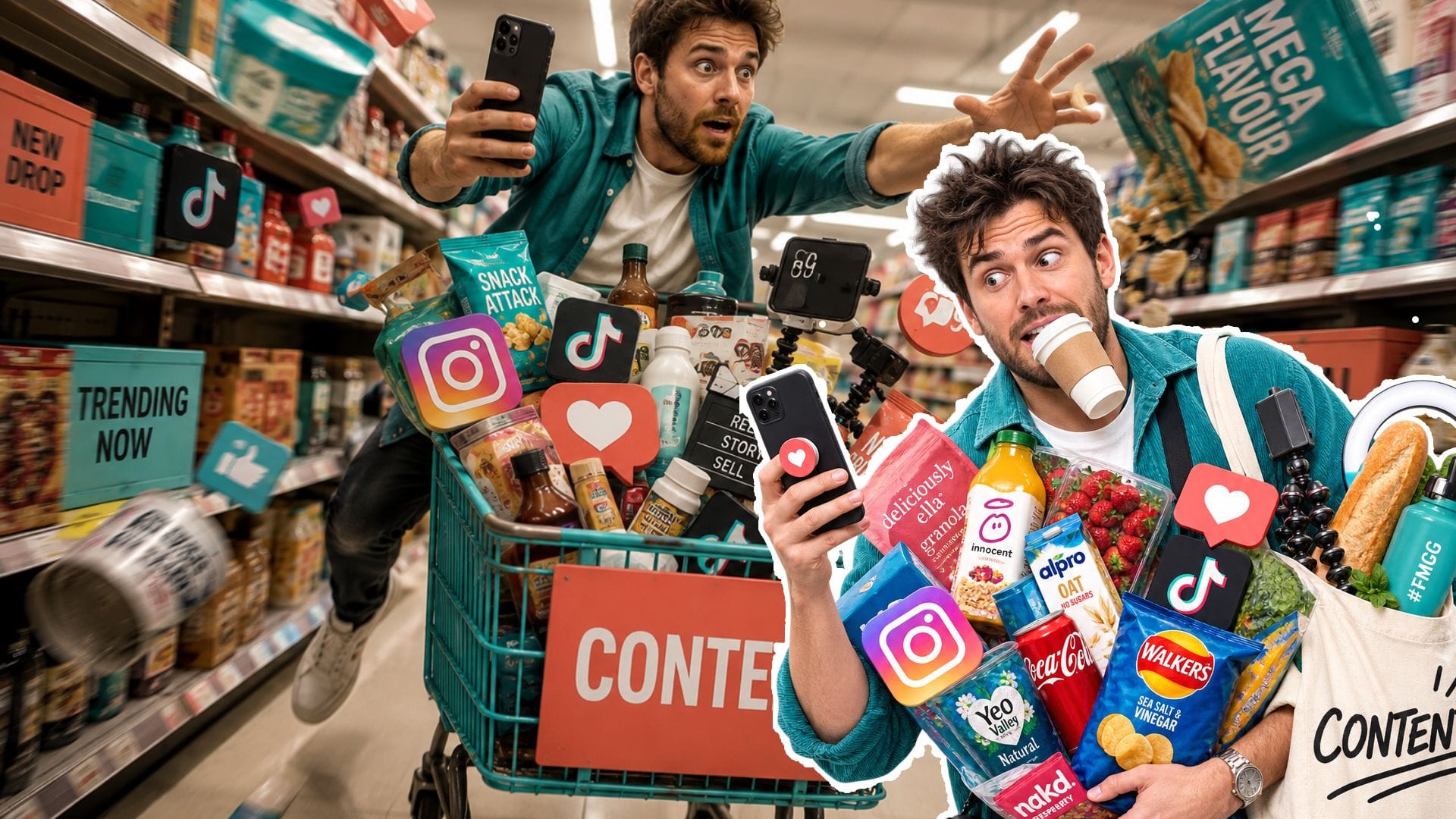

FMCG social media has two jobs. Most brands run one strategy for both. The split depends on how old your shopper is.
GWI found that 41% of Gen Z and millennials make an impulse purchase online every two to three weeks, rising to 48% among daily TikTok users. Among baby boomers the figure drops to 10%.
If your brand posts the same content for a 24-year-old on TikTok and a 58-year-old in the Tesco aisle, one of those audiences is being served by accident.
Why FMCG Social Media Has Two Jobs
For an older shopper the decision still happens in seconds at the fixture, well away from content your team spent days producing. Social builds the mental availability that makes their hand move without deliberation.
For a younger shopper, the feed increasingly is the point of purchase. Discovery, consideration and checkout collapse into a single scroll, which turns social into a direct response channel rather than a brand-building one.
Both jobs are real. Running one plan across both is where the money goes.
The Shopper Who Buys in the Feed
You might argue that the answer is to move everything to TikTok. The split runs by shoppers rather than by platform. A brand whose buyer is 55 gains very little from chasing reach among people who will never see the fixture.
Work out which half of that GWI gap in your category sits in before you set up a content plan. A chilled ready meal aimed at families and an energy drink aimed at students need different briefs, not different filters.
Content That Earns Its Place in the Feed
The brands winning in FMCG create content people would choose to watch without knowing the brand. Product-led content rarely carries that on its own.
Recipe integrations, cultural moments, behind-the-scenes production and creator-led formats all outperform static product photography in paid and organic contexts alike. Short-form video is the format that carries most of this work.
User-generated content sits at the center of the mix. In our experience, content made by real customers builds trust faster than polished brand work, at a fraction of the production cost.
Our own numbers make the case. When EMILY Snacks launched Seaweed Crisps into the Tesco Meal Deal, we built the campaign on real customer reactions. The published results included a 934% rise in social impressions and reached beyond 814,000 people.
Platform Selection for FMCG Brands
FMCG brands do not need to be everywhere. The useful question is where your specific shopper is active and receptive.
Facebook still reaches an enormous adult audience, particularly 35 and above. Instagram remains dominant for food, drink and lifestyle. TikTok is close to compulsory for under-35 shoppers, because its discovery algorithm gives challenger brands a route to reach that did not exist five years ago.
The newer platforms deserve a look. GWI reports Threads as the fastest-growing social platform across all generations, with Reddit, X and Telegram all showing sharp year-on-year growth.
Pick two or three and run them properly. Spreading thin across six produces six mediocre channels.
Community, Creators and the Share Signal
Follower counts are a vanity metric. What an FMCG brand needs is a community that advocates, produces content and comes back to buy.
Community management, meaning replying to comments and joining conversations rather than broadcasting into them, is among the most underinvested areas in the category. It is also the cheapest.
Instagram now weights shares above likes and comments as its primary distribution signal. For an FMCG brand that changes the question asked of every post, from whether people will like it to whether people will send it to a friend.
Recipes, humour, relatable moments and surprising product facts generate sends. Straight promotional content does not.
Choosing Creators for FMCG Social Media
The influencer market has matured. Mega-influencers rarely deliver the return they once did for consumer goods brands.
We consistently find micro and nano creators, between one thousand and one hundred thousand followers in a relevant niche, outperform on engagement rate and purchase intent. The skill is finding creators whose audience overlaps your shopper rather than chasing reach for its own sake.
A creator relationship running across six months delivers far more than a one-off gifting campaign with a bigger account.
Paid and Organic: Getting the Balance Right
Organic reach alone will not scale an FMCG brand. Paid social remains one of the most cost-effective ways to reach new consumers, provided the creative carries the work.
Strong UGC-led creative with a disciplined Meta strategy outperforms polished brand creative in direct response contexts. Large budgets behind weak creative produce expensive, weak results.
The strategic principle stays simple. Match creative format to objective and test ruthlessly rather than assuming what will land.
Measuring FMCG Social Media
Engagement rate, reach and follower growth are signals rather than goals. The numbers that matter in FMCG social media our share of voice, brand search volume, content-attributed retail sell-through and, where you can track it, direct-to-consumer conversion.
Connecting social activity to commercial outcomes needs a clear attribution framework and some patience. Social builds brand equity across months.
The two jobs also need two scorecards. Aisle-facing content earns its keep through brand search volume and sell-through, while feed-facing content should show up in clicks and direct sales.
Brands that abandon the strategy after six weeks because revenue has not moved will underperform every time.
Frequently Asked Questions
What type of content works best for FMCG brands on social media?
Short-form video and user-generated content consistently outperform static brand imagery. Content that entertains, educates or surprises performs best, because people send it to each other and sends are now the primary distribution signal.
Which social media platforms should FMCG brands prioritise?
It depends on your shopper. TikTok is essential for under-35 audiences, Instagram suits food, drink and lifestyle brands and Facebook reaches a broad adult audience. Choose two or three and do them well.
How often should an FMCG brand post on social media?
Consistency beats volume. Our rule of thumb is three to five well-planned posts a week on your primary platform, which outperforms daily mediocre material.
Do FMCG brands need influencers?
Creator partnerships are among the most effective tools available, particularly micro and nano creators with real authority in a niche. A structured programme compounds, whereas a one-off campaign rarely moves anything.
FMCG social media is a long game played in short moments. The brands that win treat it as a commercial channel, match the plan to the shopper rather than the trend and measure outcomes that connect to sell-through.
We build both jobs into one plan. The feed shopper and the aisle shopper each get content aimed at them.
Get in touch and we will tell you which of your two audiences your current content is actually serving.